

More Companies Are Building Resource Hubs.
Most are doing them wrong.
Chien Industries helped Treasury4 turn scattered content into a system that drives growth.


"The scope of work included building a resource hub for the startup I work at, producing over 12 pieces of fresh content that relate deeply to our ICP, and ongoing monthly services for producing a strategic content matrix of articles, guides, blogs, etc. Everything has been top notch from the get go and I am happy to have found her & team!"
–Christina Sullivan
Director of Marketing at Treasury4

It’s hard to browse a B2B website today without being asked to read something.
A blog post. A guide. A perspective on “the future of” whatever industry you’re in. Most of it is long. Much of it is well intentioned. Very little of it actually helps.
Publishing content used to be enough. Companies wrote to show they knew their stuff or to keep search engines happy. The result is a lot of information that exists, but doesn’t really go anywhere.
Treasury4 was ready for a more deliberate approach.
The Problem: Content without a Home
Treasury4 sells SaaS software for treasury teams—people whose jobs depend on knowing where money is, how it moves, and how to make better decisions with it. Their product is modern and data-driven. Their content didn’t yet reflect that.
Articles lived in a long chronological list. Topics overlapped. There was no clear starting point for someone arriving with a specific question and no structure for search engines or AI systems to understand what Treasury4 actually knew.
They didn’t need more content. They needed a place for their knowledge to live.

Resource hubs done right
Search engines—and increasingly AI—look for clarity, structure, and trust. They reward systems that behave like libraries: organized by topic, internally connected, and built around real questions with real answers.
Working closely with Treasury4’s SMEs, we mapped personas, pain points, industries, and content pillars. We built around how understanding actually unfolds (not how companies wish buyers would behave).
The resource hub content quickly found its way into everyday use—shared in conversations, emails, and outreach, and used internally as a clearer expression of the company’s expertise.
1
1
2
2
Mapped Real Buyer Questions
Personas, pain points, industries
Built Content Pillars
Organized around how understanding unfolds
3
3
4
4
Designed the Hub Like a Library
Connected topics, clear starting points, internal pathways
Made Expertise Usable Daily
Shared in emails, outreach, internal conversations
What does this look like forTreasury4?
A resource hub built to engage your audience
Trending resources can be found at the top of the page, making it easy for you to start your learning journey. This intention shows your visitors that you care, and a polished interface keeps it professional.
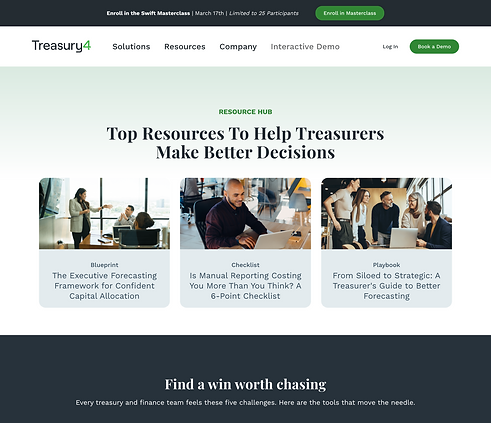

...guides you through the hub
A complete resource hub organized by goal that allows readers to get the information that they need without sifting through nonsense.
...has well-researched resources created by experts
Nice layouts are just the start. Well-researched and useful information make readers engaged and more likely to come back for more.
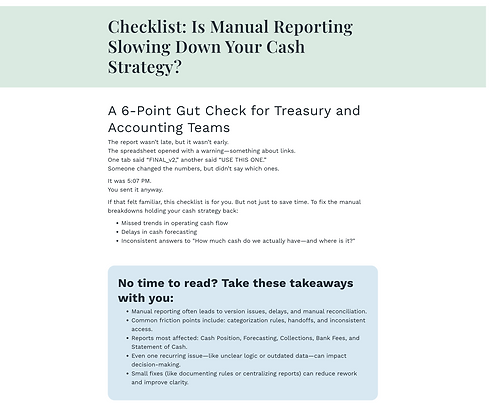

...features multiple resource types for multiple needs
It makes the resource hub multi-dimensional which adds to credibility and appeals to a wider audience, keeping readers engaged in the process.
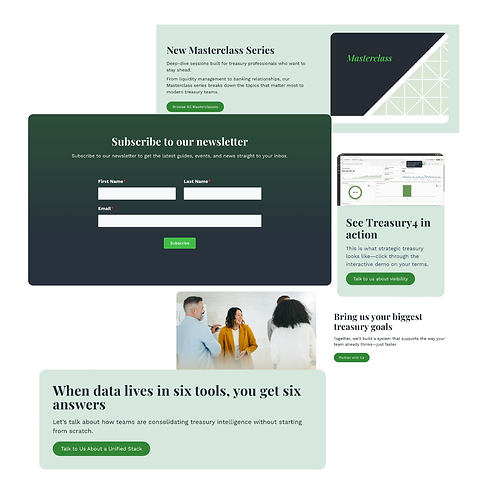
...and prompts you to take action
Strong resource hubs integrate multiple call-to-action boxes that urge users to do a clear action. These are strategically placed and are effective in conversion.
Most companies think of resource hubs as a nice-to-have
But the best ones earn their keep. They help buyers find answers without friction. They give machines something coherent to trust. And they quietly shorten the distance between curiosity and conversion.
Treasury4 didn’t suddenly become a different company. But it began to look like what it already was: credible, modern, and ready for serious conversations.
When expertise has a home
What started as a content cleanup became a stronger expression of Treasury4’s expertise.
Visitors Stay
Visitors stay longer in the resource hub than on product or demo pages.
Instead of bouncing, readers settle in.
Readers Explore
People view more pages per visit than average.
The structure invites curiosity.
Intent is High
Engagement remains strong even with relatively low traffic.
The right readers are finding the right answers.
Top-Performing
The resource hub is already among the site's top-performing pages.
Organization amplified content that already existed.



How do you think about success for something like a resource hub?
[Placeholder text]
Has the hub influenced how Treasury4 presents itself more broadly?
[Placeholder text]
How did working with an external agency shape the outcome?
[Placeholder text]
How did the resource hub change the way Treasury4 shows its expertise without needing to say it outright?
[Placeholder text]
What role did clarity and readability play, given how technical treasury content can become?
[Placeholder text]
For other marketing leaders considering a resource hub, what did this project reinforce for you about how buyers want to learn?
[Placeholder text]
Q&A with Christina Sullivan
-
Oversized fit
-
Scoop neckline
-
Short sleeves
-
Breathable
-
95% cotton
-
Conscious